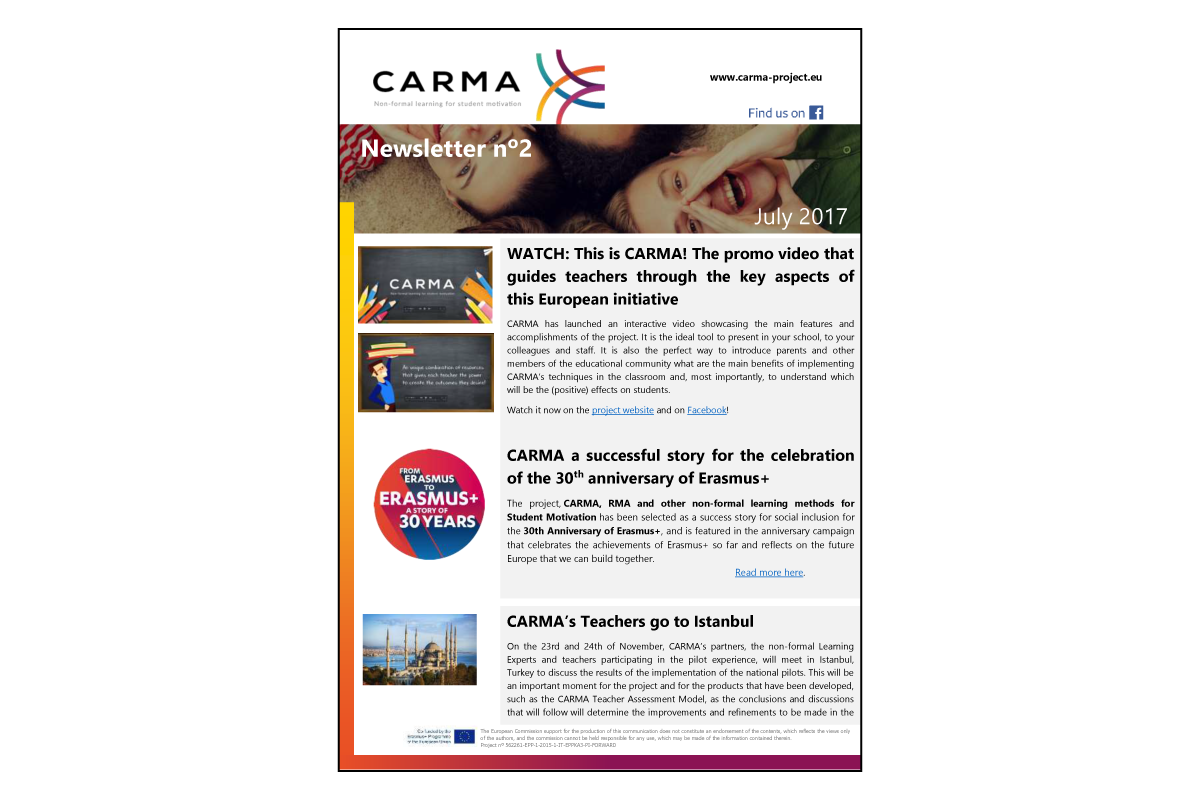
The second CARMA newsletter details the selection of CARMA as a success story for social inclusion for the 30th Anniversary of Erasmus+ and its new video.


Contributes to the development of society, innovation and knowledge.

Help develop measures to counter violence and discrimination.

Supports adults in enhancing skills to promote their professional growth and participation in social and civic life.

Promotes quality and efficiency in education.

Supports and promotes educational activities, training courses and mobility projects aimed at young people.

CESIE ETS is a European center for studies and initiatives based in Palermo, Sicily.
The second CARMA newsletter details the selection of CARMA as a success story for social inclusion for the 30th Anniversary of Erasmus+ and its new video.

The reader aims at helping teachers analyze “critical incidents”, which come up through their work with children or parents from other cultural backgrounds, and facilitate the identification of concrete solutions to the problem.

This handbook contains two introductory texts and 15 activities developed and tested to specifically address diversity and non-discrimination during early childhood education.

The purpose of the reader is to provide well working practices about involving parents through case studies and activities.

The report explores the real needs and quantifies these needs to gain a deeper knowledge on how to adapt the non-formal learning methods (to be introduced during the piloting phase) to each community and respective school system.

This report shows the findings from the evaluation of the learning outcomes of teachers who attended the European Workshop for collaborative competencies for Teachers as part of the project CARMA – RMA and other non-formal learning methods for student motivation.

This report is a result of an in depth research study for the project CARMA – RMA and other non-formal learning methods for student motivation, carried out across 7 European countries (Italy, Spain, France, Portugal, Turkey, Belgium and Austria)

This newsletter details the progress made on the project CARMA – RMA and other non-formal learning methods for student motivation since it began in January 2016.

The overall objective of this anthology is to contribute to the development of education policies and practices on intercultural education, gender equality education and the inclusion of pre-school children.

Download SMART teachers’ training needs analysis!

SMART – Literature Review Report on existing practice in measuring success factors in second chance education. The SMART literature review aims at developing an insight of the existing practice of measuring and evidencing success factors in second chance...

SMART – Evidencing success factors in informal learning: Handbook for policy-makers The SMART Handbook for policy-makers makes policy recommendations and provides guidelines to structure a quality assurance system that evidences success factors of second chance...

SMART – Teachers’ handbook The SMART Teachers’ handbook is a guide for teachers to enable them to implement self-monitoring and self-evaluation of their practice. It was used as support guidelines during the training process. It complements the training module but can...

SMART – Organisational guidelines The SMART Organisational handbook details how organisations can support the introduction of the measurement of soft skills in second chance educational settings. Key aspects addressed include the culture of the organisation, the...

[su_heading size="20"]SPACIT - GI Society Leaflet[/su_heading] A leaflet for teachers/ teacher educators / curriculum developers / Ministries which raises awareness of the GISociety and its significance to European citizens and education. The leaflet promotes the...