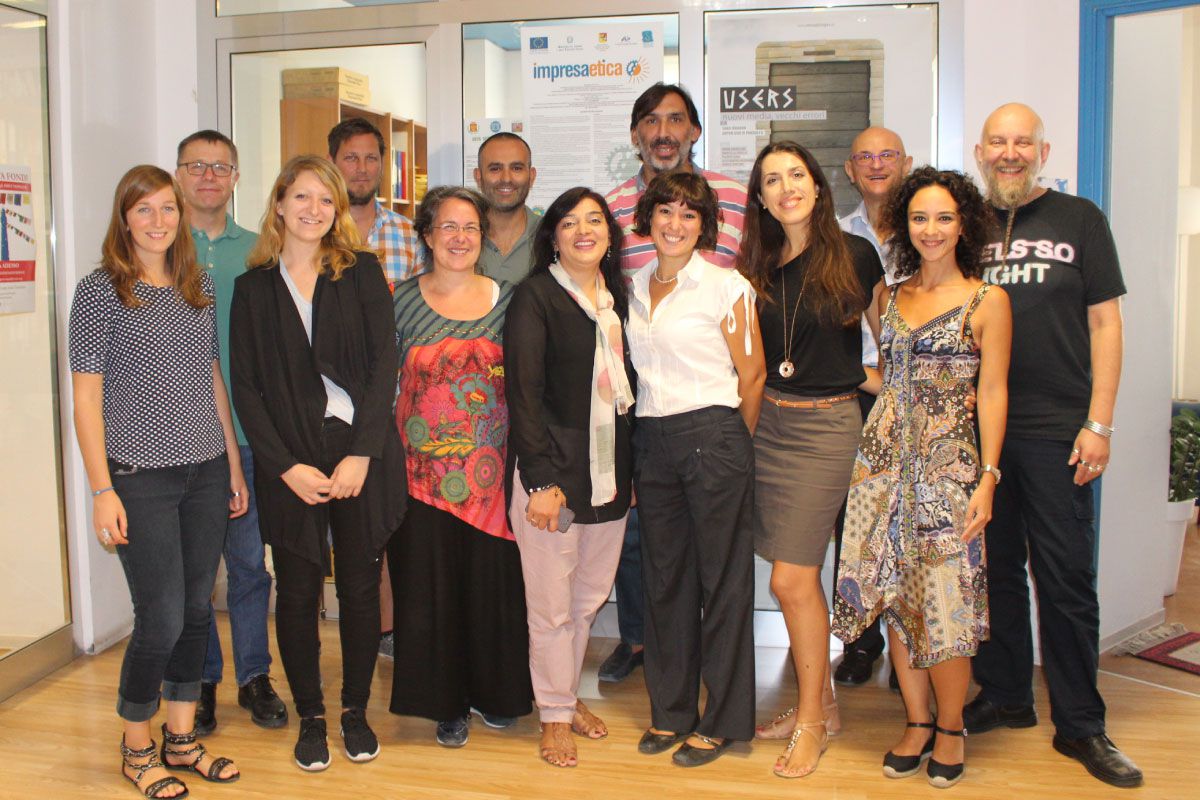
 The second partner meeting of the project LangMOOCs – Language Massive Open Online Courses was held in Palermo, Italy, on 10th and 11th of September 2015, hosted by CESIE.
LangMOOCs is a project funded by the Erasmus + Programme, Key Action 2 – Strategic Partnerships in the field of adult education, coordinated by Active Citizens Partnership (Greece), and involving CESIE (Italy), Iberika education group gGmbH (Germany), Dacorum Council for Voluntary Service (United Kingdom) and Høgskolen i Sør-Trøndelag (Norway) as partners.
The idea behind the project is to spread the use of Massive Open Online Courses for language learning in non-academic institutions. As a matter of fact, most MOOCs at international level are provided by Universities and Higher Education institutions. Therefore, the project aims to promote MOOCs’ potential for language learning among other segments of public too. For this reason, LangMOOCs’ primary target groups are schools and other education providers, language teachers, trainers but also individual learners.
The second partner meeting in Palermo was a chance for partners to discuss about the progress of the project, starting from the completion of the first project output, the research report on MOOCs’ pedagogical framework, which will be soon made available on the project website.
The research will now be carried further: after a comprehensive analysis of general MOOCs framework across different fields, the partners will now focus their study on available MOOCs for language learning: to this aim, a first selection has been made among the most common platforms where language MOOCs are available, so as to prepare the ground for the development of a toolkit on how to develop and deliver a MOOC for language learning, and for the production of five Open Educational Resources for language learning (in all partners’ languages: Greek, Italian, German, English and Norwegian) based on authentic materials.
During the second meeting, all partners showed to have increased their awareness of the project objectives and activities, and to have become more familiar with the topic of Massive Open Online Courses and open education. All participants had a fruitful exchange of opinions and feedback on the work done so far, and more importantly, a common understanding of the next steps to take.
Over the next few months, the consortium will therefore deliver a second research report containing a classification and evaluation of existing MOOCs for language learning, as well as a toolkit containing guidelines on how to develop a Massive Open Online Course.
For further information about the project, please follow us on Facebook and Twitter, or write to : francesca.vacanti@cesie.org
 The European Commission support for the production of this publication does not constitute endorsement of the contents which reflects the views only of the authors, and the Commission cannot be held responsible for any use which may be made of the information contained therein