The transition towards green and sustainable development is a long-term process, and education has a central role in making it possible. Universities need to prepare students not only to understand sustainability challenges, but also to develop the competences, knowledge and skills needed to contribute to a greener and more sustainable society.
This requires changes that go beyond individual projects: new curricula, stronger institutional capacity, innovative teaching approaches and policies that can support change over time.
For Armenia and Moldova, this has been at the heart of RE-GRAD. As the project approaches its conclusion, attention is now turning to an essential question: how can the results achieved continue to generate impact beyond the project lifetime?
Making change sustainable
RE-GRAD has worked on different levels of higher education transformation, from strengthening academic staff capacity to redesigning undergraduate programmes and developing frameworks for Education for Sustainable Development and sectoral qualifications.
Some results have already moved beyond the project level. In Moldova, the Concept for the integration of Sustainable Development Goals into Higher Education programmes has been officially approved at national level. In Armenia, four Sectoral Qualifications Frameworks covering Management, Biology, Construction and Geomatics have also received national approval.
These developments create conditions for the work initiated through RE-GRAD to continue through institutional practices, academic programmes and national higher education processes.
Sustainability therefore becomes more than maintaining individual project activities. It means ensuring that the knowledge, competences, tools and partnerships developed through international cooperation can continue to be used and further developed.
Looking beyond RE-GRAD
The final stage of the project provides an opportunity to reflect on these achievements and, importantly, on what comes next.
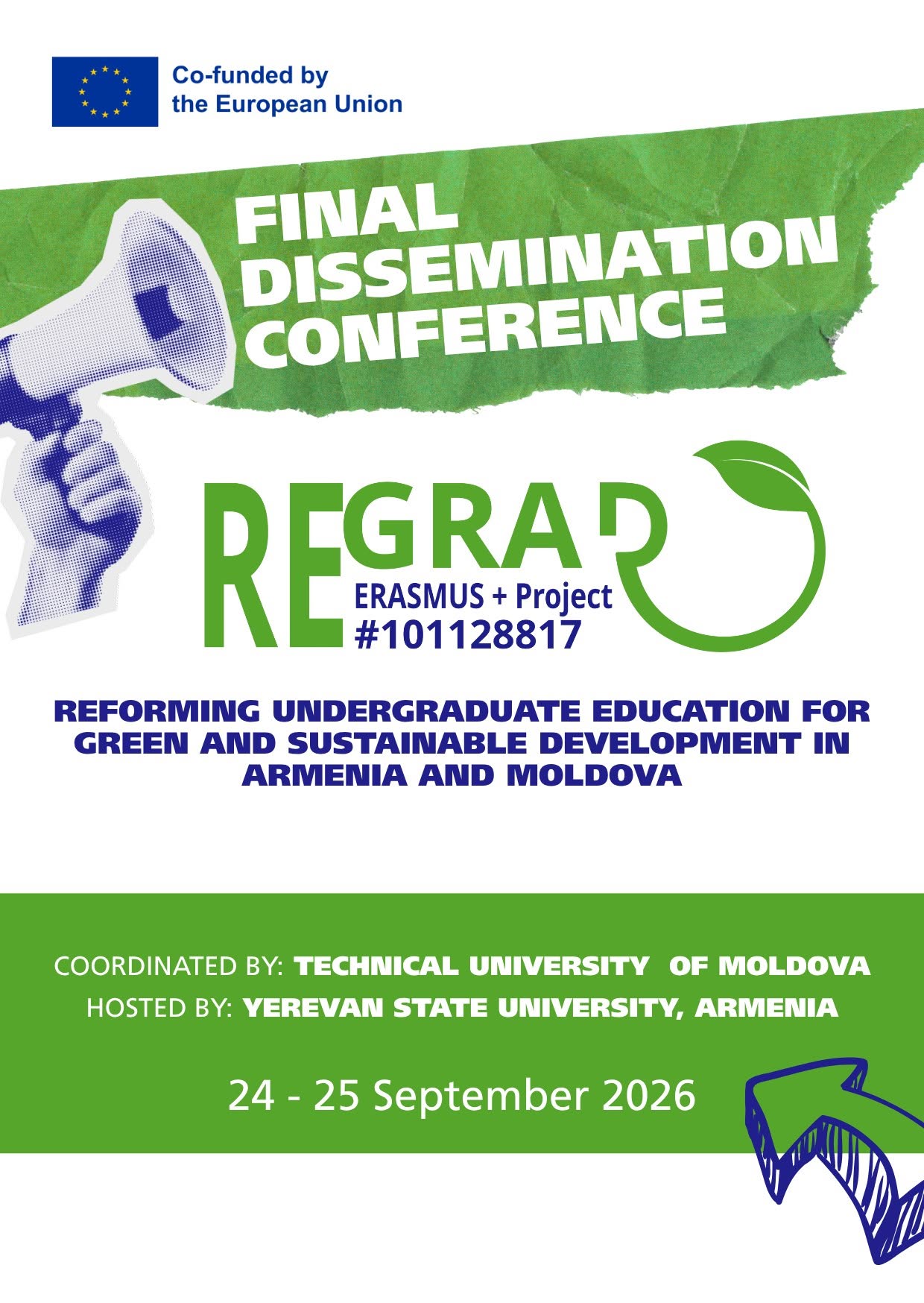
The RE-GRAD Final Dissemination Conference, taking place in Yerevan (Armenia) on 24–25 September 2026, will bring together the consortium’s 12 partners from five countries, including the Ministries of Education of Armenia and Moldova, higher education institutions and other stakeholders.
The conference will showcase the main project results, including the Concept of Education for Sustainable Development, green and digital competences, redesigned Bachelor’s programmes, Sectoral Qualification Frameworks, innovative teaching and learning approaches, strengthened academic capacity and international cooperation.
Beyond presenting results, the event will create space to discuss the sustainability and institutionalisation of project outcomes, exchange experiences and explore opportunities for cooperation beyond RE-GRAD.
The conclusion of RE-GRAD is therefore not simply the end of a project. It is an opportunity to consider how the foundations created through international cooperation can continue to support education for green and sustainable development in Armenia and Moldova – and how new partnerships can build on them.
Interested in developing a similar CBHE project or exploring opportunities for cooperation on green and sustainable higher education? Contact CESIE at research@cesie.org to discuss your ideas and potential collaboration.
About the project
RE-GRAD – Reforming Undergraduate Education for GReen and Sustainable Development in Armenia and MolDova è un progetto finanziato dal programma ERASMUS-EDU-2023-CBHE-STRAND-3.
Partners
- Technical University of Moldova (Moldova, coordinator)
- The Ministry of Education and Research of the Republic of Moldova (MER) (Moldova)
- Bogdan Petriceicu Hasdeu State University of Cahul (Moldova);
- Ministry of Education, Science, Culture and Sports of the Republic of Armenia (Armenia)
- Yerevan State University (Armenia)
- National University of Architecture and Construction of Armenia (Armenia)
- CCI France Moldavie (Moldova)
- Armenian Center for Education Policy and Management (Armenia)
- University of Sannio (Italy)
- University of Strasbourg (France)
- Transylvania University of Brasov (Romania)
- CESIE ETS (Italy)
For further information
Read more about the projec, visit https://regrad.utm.md/ and follow us on Facebook and Linkedin.
Contact research@cesie.org