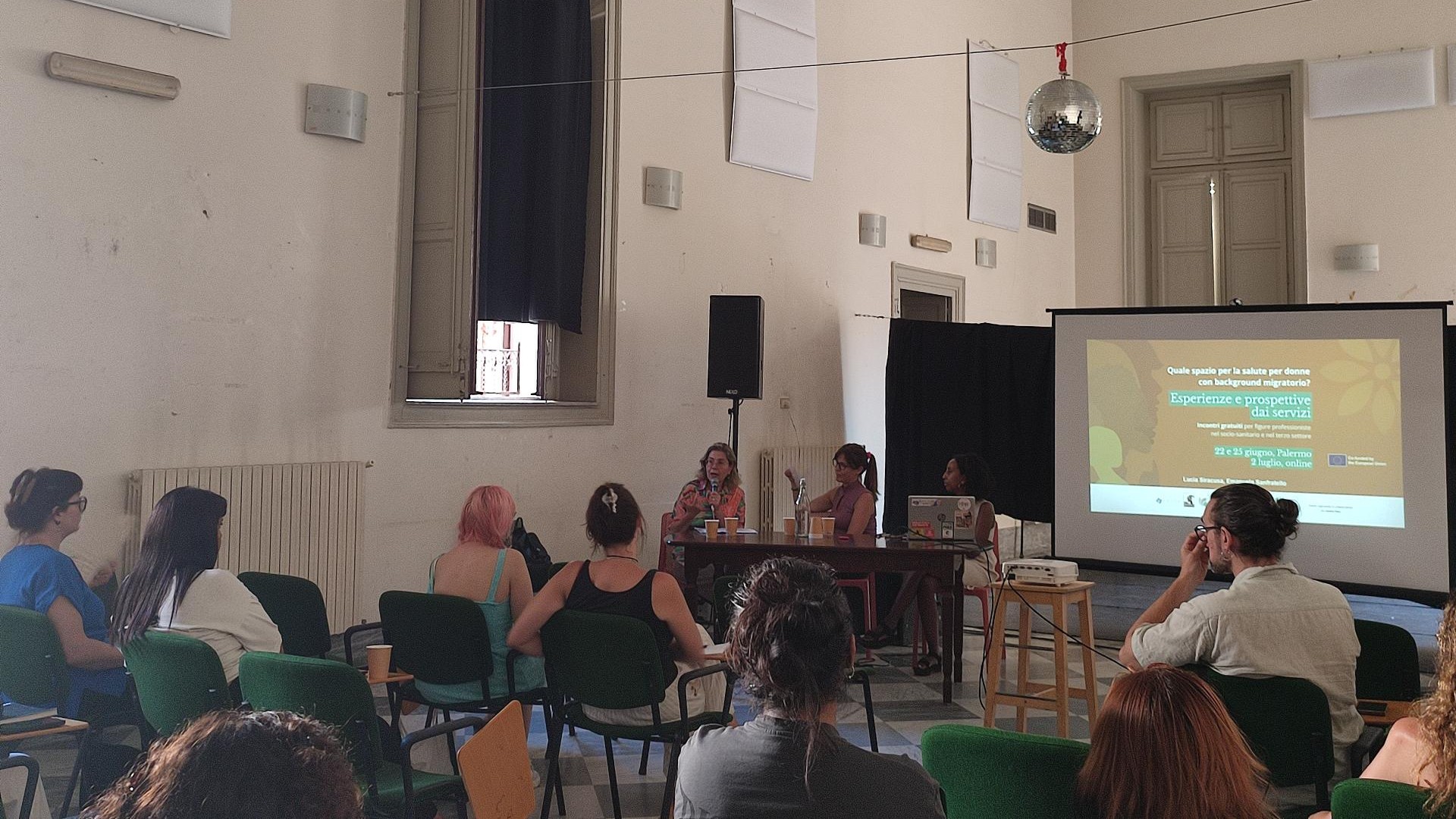
How can we make sport a truly safe and welcoming space for women and LGBTQIA+ people? We travelled to Porto for a full day of training on gender, intersectionality, and inclusion in sport: a moment of collective reflection to begin changing the rules of the game.
SISTERS aims to promote the full inclusion of women and the LGBTQIA+ community in sport, addressing discrimination based on gender and SOGIESC (sexual orientation, gender identity, gender expression and sex characteristics) through an intersectional approach.
Project partners gathered in Porto for a one-day international training dedicated to gender and LGBTQIA+ equity in sports. Between francesinhas and pastéis de nata, we spent an entire day exploring gender in all its forms; identities, expressions, orientations, etc. We unpacked acronyms that sometimes seem almost unpronounceable, like SOGIESC and LGBTQIA+, yet are crucial to represent the many nuances that make up human diversity.
This transnational gathering aimed to equip partners with knowledge and tools to navigate the complex intersections of gender, identity, and inclusion, with an added twist: applying it all to the world of sports. Through participatory activities and collective reflections, partners began shaping what will become the Sports Bag, a training manual designed to guide sports managers and athletes towards more inclusive and equitable sports environments.
Curious about what you’ll find inside that bag? Follow me in a quick recap of the international training by topic:
Introducing gender
What do Elton John, Ellen DeGeneres, Elliot Page, Caster Semenya, and David Bowie have in common? Yes, they are famous, but they also represent individuals who challenge cisnormativity and heteronormative expectations. Some are homosexual, others transgender, intersex, or gender-fluid. The training began by defining key concepts such as gender identity, sexual and romantic orientation, gender expression, cisgender, transgender, queer, SOGIESC, the gender binary, and the gender spectrum. Do you know what all these mean? Understanding gender terminology is the first step toward inclusion.
Intersectionality and inequality
Once the basics were clear, it was time to add a new layer of complexity: intersectionality. Each of us embodies multiple identities (gender, age, ethnicity, disability, sexual orientation, socio-economic background) which overlap and shape our opportunities and challenges. After acknowledging that all of us hold different positions in the wheel of privilege and power, we reflected on a simple but deep question: How can we ensure that everyone truly has the same opportunities?
To answer that, we explored the difference between equality and equity. Equality gives everyone the same support; equity recognises that people start from different positions and therefore need different forms of support to reach the same outcome. We also discussed concepts such as privilege, heteronormativity, gender-based violence, patriarchy, classism, feminism, discrimination, and minority rights, all essential for understanding how inequalities persist and how they can be dismantled.
SOGIESC-based discrimination in sports
To make the topic tangible, we turned to the headlines. We discussed recent cases such as Imane Khalif vs. Angela Carini and Justin Fashanu, analysing them through the lens of what we had learned.
From real cases to global policies, our reflection eventually reached the International Olympic Committee (IOC) Framework on Fairness,Inclusion and Non-Discrimination. We examined where it succeeds and where it still falls short. Despite being non-binding and lacking strong accountability measures, it marks a significant first step toward building more inclusive sporting environments worldwide.
This encounter was a preparatory step for partners to co-develop the Sports Bag and soon bring it to sports clubs. The project will equip over 120 sports professionals (coaches, managers, and trainers) to foster gender-sensitive governance, while raising awareness among more than 240 athletes on gender and SOGIESC-based discrimination in sports.
The meeting brought together a mix of cultures, perspectives, and experiences, a true snapshot of Europe’s diversity. Some partners voiced concerns about how such discussions might be received in their local contexts, fearing misunderstanding or backlash. Yet, that is precisely why this project matters. These conversations – at times challenging, often eye-opening – are the very ones needed to question the status quo and to make sports a space where everyone, regardless of gender or identity, truly belongs. In an ideal world, initiatives like this would no longer be needed. Until that day comes, we keep going, step by step, conversation by conversation, towards a more inclusive and equitable future for all.
About SISTERS
SISTERS is funded by the European Education and Culture Executive Agency (EACEA), under the Erasmus Sport programme, a project aiming to promote women’s and the LGBTQIA+ community’s full inclusion in sports by advancing equity through an intersectional approach.
Partners
- CESIE ETS (Italy, coordinator)
- Associaciao de Futbol do Porto (Portugal)
- Champions Factory (Bulgaria)
- Symplexis (Greece)
- CSI Center for Social Innovation LTD (Cyprus)
- SARAJEVO SUSRET KULTURA – SMOC (Bosnia-Herzegovina)
For further information
Read the project factsheet and follow us on Facebook and Instagram
For more information, contact Soad Ibrahim, soad.ibrahim@cesie.org.
Website: https://sisters-project.eu/